
The Challenge
Professional athletes are financial outliers. Careers are short, peak earnings are concentrated into a handful of years, income is often multi-currency, and obligations can include complex property payment schedules across markets like Dubai. The wealth managers who work with them don't need another generic portfolio tool — they need a dashboard that models this kind of income trajectory honestly, stress-tests it, and lets the athlete understand the plan from the same source of truth.
Sport Legacy came to us with that exact brief: build an advisor-and-athlete-facing platform for "the new standard of athletic wealth" — a digital vault where financial data, legacy planning and actionable wealth modeling sit together.
What We Built
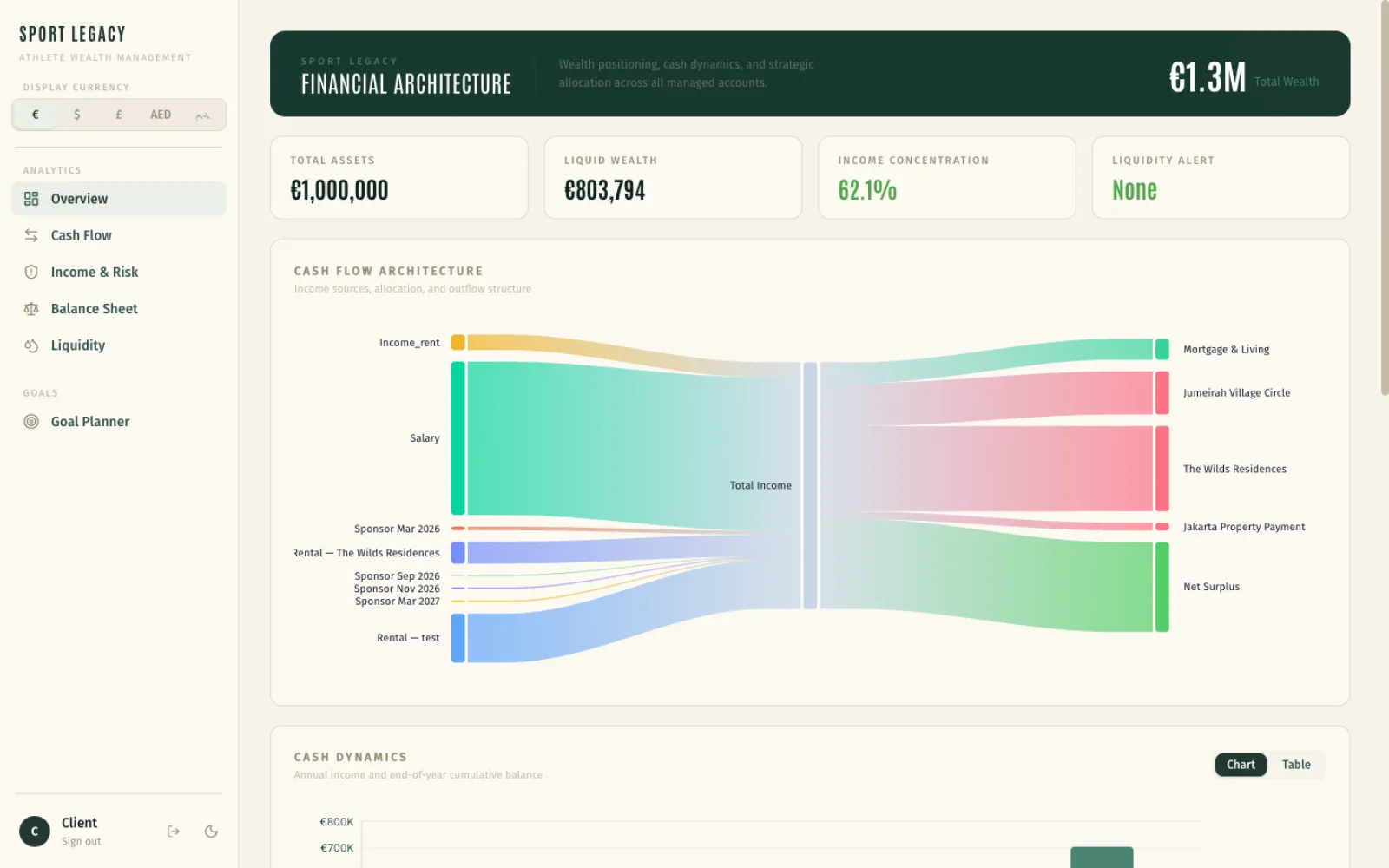
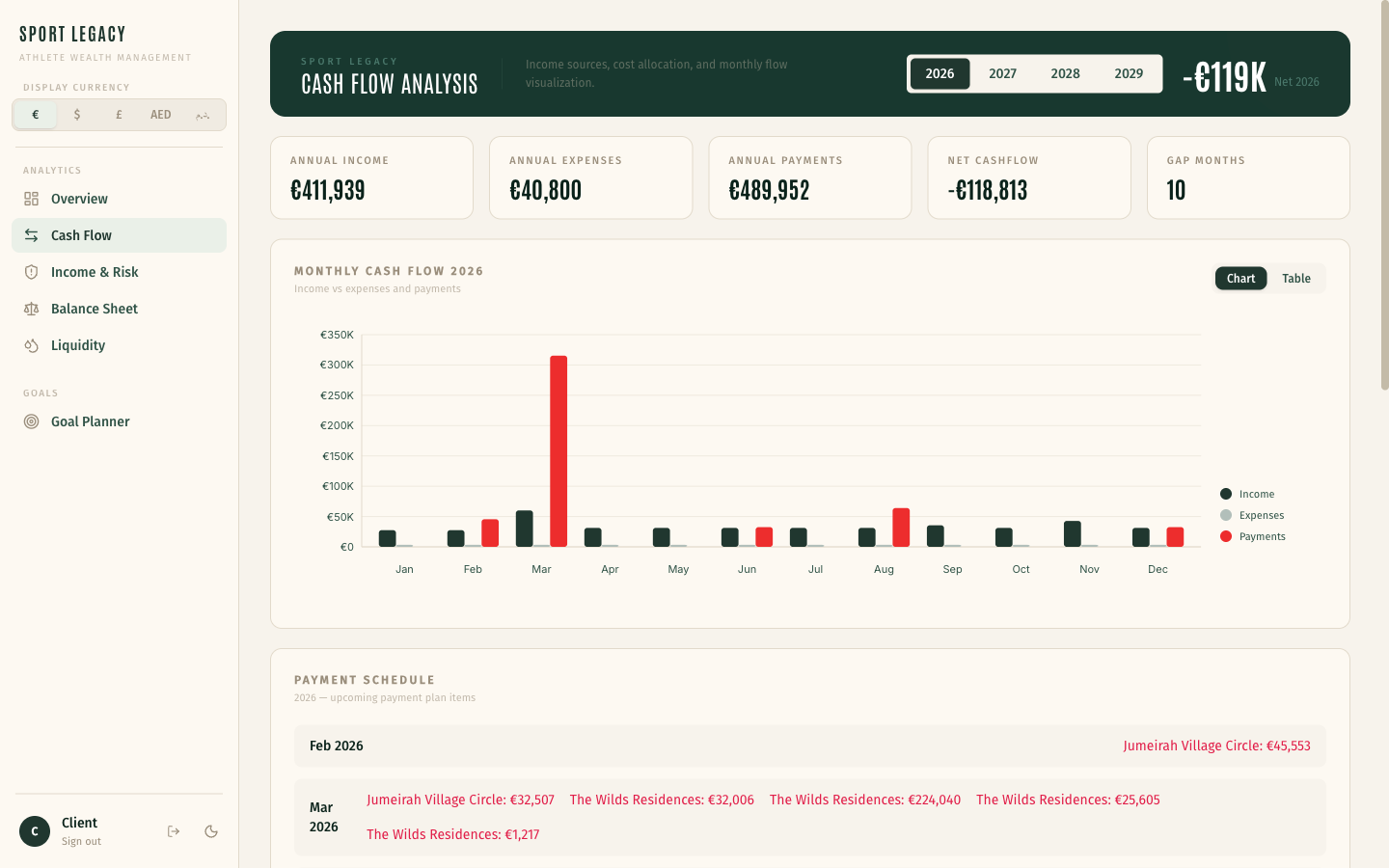
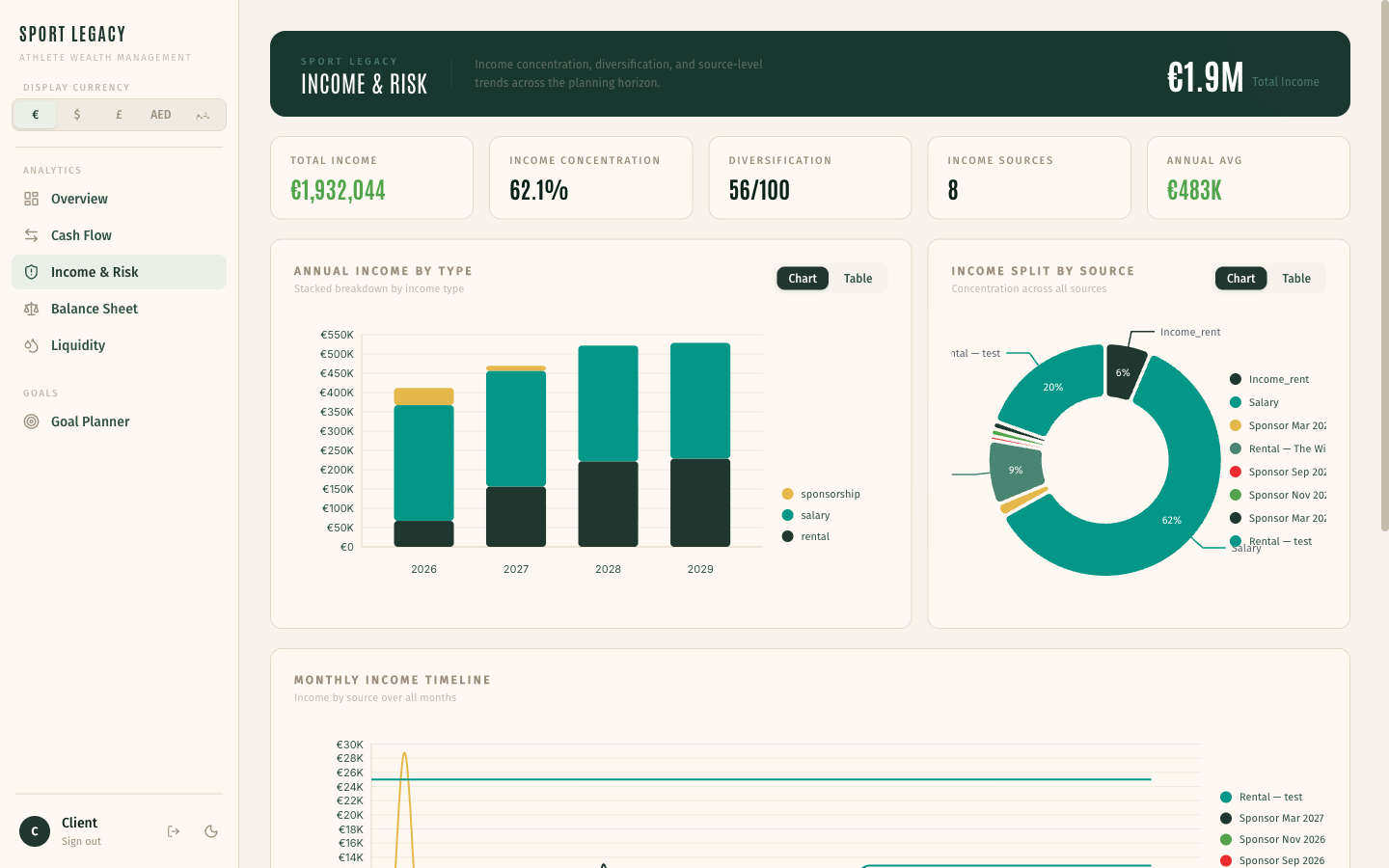
A full dashboard application covering ten areas of the financial picture: Overview, Cash Flow, Income & Risk, Balance Sheet, Liquidity, Goal Planner, Wealth Modeling, Financial Data, Client Management and Settings.
Under the surface, the interesting pieces are:
- A multi-currency cashflow model across EUR, USD, GBP, AED and MAD, with live exchange-rate syncing rather than static conversion tables
- A deterministic financial engine that computes monthly cashflow, annual summaries, savings and investment contributions, payment-plan obligations, balance sheet, net worth, liquidity runway and alerts from the same client profile
- Advanced advisor-only wealth modeling across percentage adjustments, absolute income/expense changes, property purchases, lump-sum investments, targeted debt payoffs and custom growth-rate assumptions
- Goal-based planning for net worth targets, passive income targets, financial-independence age and savings milestones, so clients can track progress against a plan instead of just viewing charts
- AI-assisted payment-plan extraction via the Vercel AI SDK and OpenAI GPT-4o-mini, turning uploaded property sales-offer PDFs into structured project, developer, installment, delivery-date and expected-yield data for advisor review
- A role-aware access model on Supabase Postgres — wealth managers can manage the full client book and advisor tools, while client users are locked to their own linked profile and goals through route guards and row-level security
How We Built It
Three architectural choices define this codebase:
The engine is pure. engine.ts, scenario.ts and projections.ts are deterministic, side-effect-free TypeScript modules. Data fetching lives in api.ts. UI lives in components. This separation means the financial logic is testable with Bun's test runner in isolation — no mocked Supabase, no mocked UI — and the numbers on screen always match the numbers in the spec.
RLS at the database, not in the app. Access is enforced in Postgres policies rather than in app-layer checks. That's the only way to give a client user a read token that genuinely cannot see another client's data, and it's what a wealth advisory must have before it can put this in front of a compliance team.
AI captures documents; the engine owns the financials. The OpenAI layer is used where it is strongest: extracting structured payment-plan data from messy property PDFs. It does not compute the client's financial position. The scenario engine stays auditable; AI accelerates data entry. Keeping those concerns separate is what makes the product usable in a high-trust domain.
The Outcome
Sport Legacy has a platform that lets advisors and athletes work from the same financial picture. Cashflow, assets, liabilities, liquidity, income concentration, goals and modeled future decisions all resolve back to the same computed client profile.
Operationally, the advisory team can onboard clients, create user accounts, manage payment schedules, save and version modeling scenarios, and import real-estate payment plans from PDFs without bespoke engineering.
Why It Matters
The brief for a dashboard like this is trivially easy to botch. Pile on charts, call it "AI-powered," ship. The work here was the opposite: a small, correct financial engine; deliberate AI where document automation saves real advisor time; and access control strong enough to separate wealth-manager and client views properly. That's the difference between a demo and a system a wealth advisory can actually run a business on.