
The Client
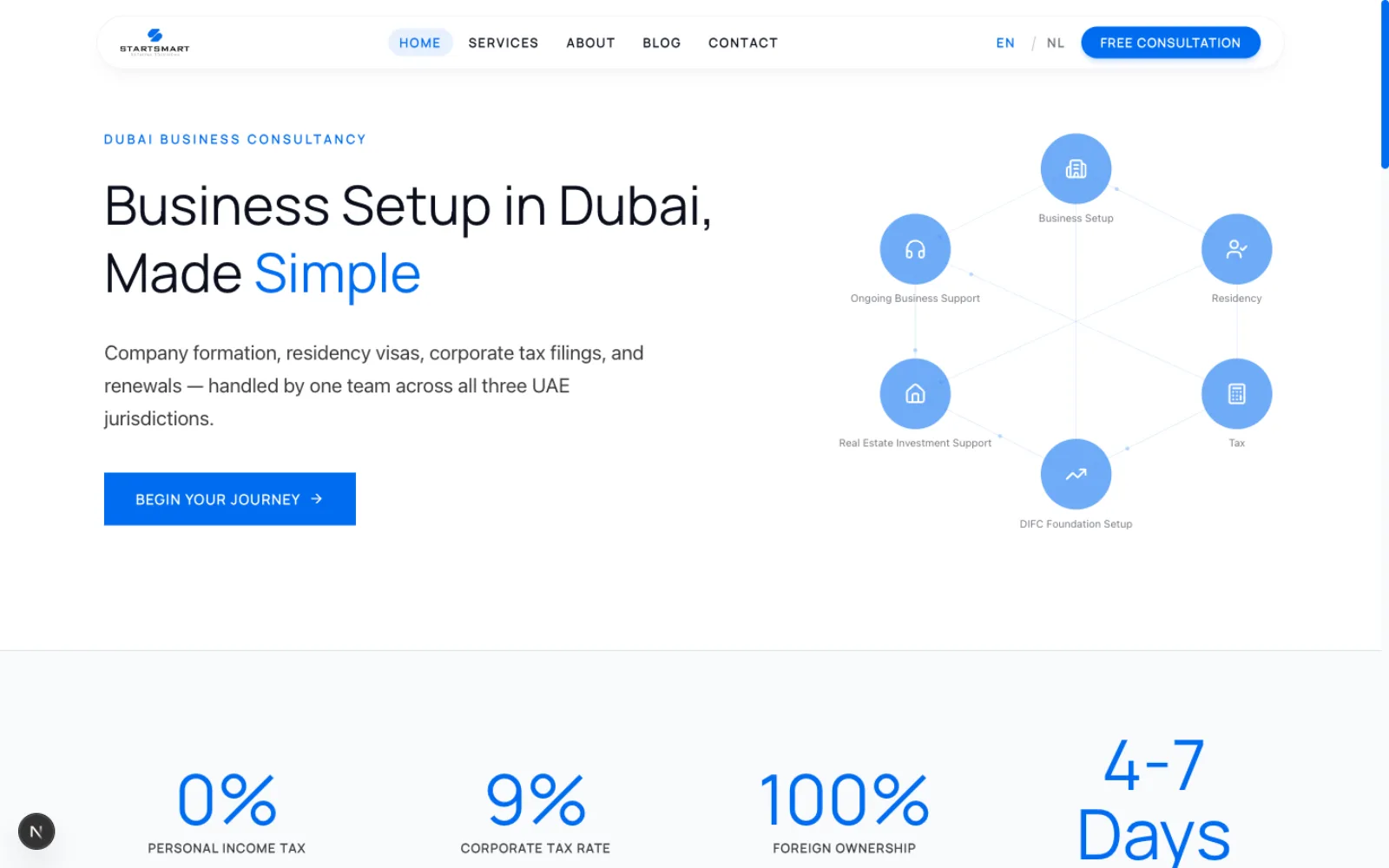
StartSmart is a Dubai-based business-setup consultancy operating from Business Bay. They help entrepreneurs, investors and expat families establish companies, secure residency visas and stay compliant across all three UAE jurisdictions — Mainland, Free Zone and Offshore. It's a category where trust is the entire product: clients are making a multi-year commitment to a country and a team, often before they've ever met them in person.
The Challenge
StartSmart's website wasn't doing the consultancy justice. A credible prospect — someone about to relocate their business and family to Dubai — needs to find enough depth on a single site to form an opinion: what's the jurisdiction mix, what's the process, who's behind the firm, how do they handle tax and visas, and are they serious?
The brief was to ship a real website — not a template, not a landing page — that could:
- Explain a broad catalogue of services in enough depth that a serious prospect never has to leave the page to feel informed
- Serve both English-speaking international audiences and Dutch-speaking expats looking at Dubai, without the stiff, machine-translated feel that plagues most bilingual sites
- Load fast, rank well, and convert visitors into booked consultations
What We Built
The public website at startsmart.ae — a complete marketing surface for the firm:
- A bilingual routing layer in English and Dutch, with
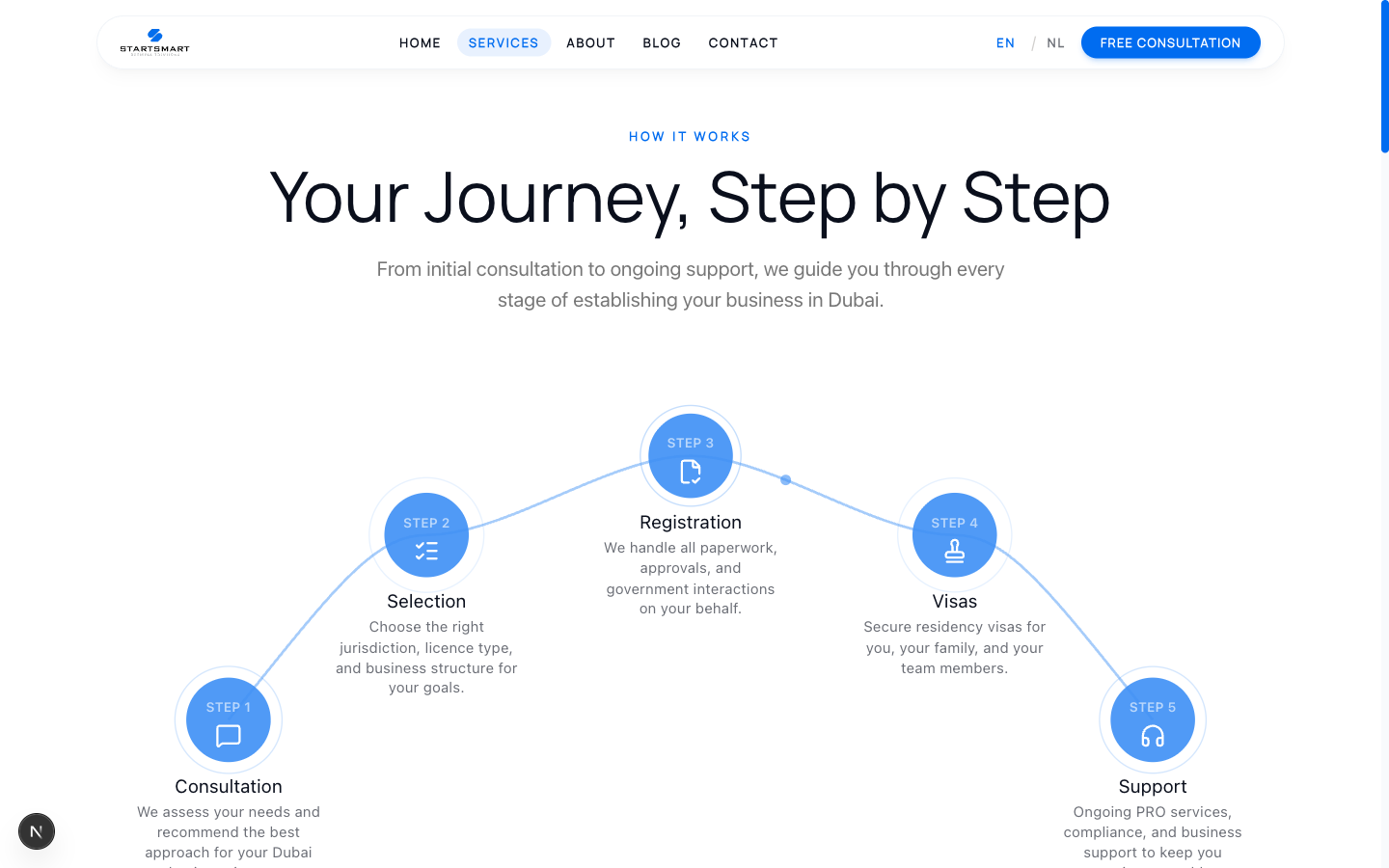
next-intldriving the message catalogue,as-neededlocale prefixing, and correct hreflang alternates in every page's metadata - Six service detail pages — each with process steps, required documents and benefits: Business Setup & Structuring, Residency & Relocation, Tax & Compliance, DIFC Foundation Setup, Real Estate Investment Support, and PRO Services (Ongoing Business Support)
- A team page with leadership profiles — Managing Director, Head of Business Set Up, and Head of IT — giving prospects the credibility signal that a faceless landing page can't
- An FAQ system with 12 questions across four categories (Company Formation, Tax & Compliance, Visas & Residency, Practical), backed by FAQ-page structured data for rich results in search
- A WhatsApp-first contact flow — the form collects name, email, service interest and message, then opens a prefilled WhatsApp conversation with the StartSmart team. Client-side, no server required, and culturally aligned with how business communication works in the UAE
- Home, About, Team, Services (×6), Blog, Contact, Privacy, Terms and Imprint — the full content shape a prospect expects from a credible firm
- A blog module with locale-aware slug routing, ready for content marketing
- JSON-LD structured data throughout — Organization, Service, BlogPosting, FAQPage and BreadcrumbList schemas give search engines machine-readable context on every page
- Motion and polish via Framer Motion on the hero and process timeline — restrained, not performative
- SEO infrastructure: sitemap generation, robots.txt, metadata alternates for hreflang, security headers at the Vercel edge, and clean URL redirects so link equity survives future restructures
How We Built It
Five choices define the codebase:
Typed service data, not MDX prose. Every service — business setup, residency, DIFC foundations, real estate, tax, PRO services — lives in services-data.ts as a strongly-typed object with process steps, required documents, benefits and CTAs as structured arrays. Pages render from that single source. Adding a new service takes minutes, not hours, and translations line up by shape because EN/NL slug parity is enforced at module load.
i18n at the routing layer. Rather than bolting translations onto individual components, the [locale] segment is the source of truth. next-intl handles message catalogues, and localePrefix: "as-needed" keeps English URLs clean while prefixing /nl/ only when needed. Pages, sitemaps and metadata alternates are generated per-locale automatically, which means hreflang is correct, canonical URLs are correct, and the site is genuinely bilingual at the infrastructure level — not just in the copy.
Performance as a first-class constraint. Tailwind v4, the Next.js App Router, and deliberate image and font choices keep the Lighthouse scores where they need to be for a site competing on organic search in a high-intent category.
A deliberate design language. Dark navy palette, Islamic geometric star patterns, art deco line elements and geometric frames give the site a visual identity that reads "Dubai consultancy," not "SaaS template." The design direction was intentional — this is a firm that operates in Business Bay and advises on DIFC foundations; the aesthetic had to match.
WhatsApp-first contact. In the UAE, WhatsApp is how business gets done. The contact form prefills a WhatsApp message with the prospect's details and selected service, so the StartSmart team can respond in the channel their clients already use. The message body is always composed in English for consistent staff triage, with a language tag so the team knows whether to reply in English or Dutch.
The Outcome
StartSmart now has a website that looks and reads like the serious UAE consultancy they are. The team page puts names and faces behind the firm. The FAQ system lets prospects self-serve on the most common questions — jurisdiction differences, costs, timelines, visa categories — before they ever pick up the phone. And the structured data gives Google the machine-readable context it needs to surface rich results.
The bilingual setup opens the Dutch-speaking expat audience without fragmenting the rest of the site, and the SEO foundation is in place for content marketing to compound over time.
Operationally, adding a service, a translation, a blog post or a landing page is a routine operation rather than a project — which matters in a business where regulations and jurisdictions shift every year.
Why It Matters
Plenty of consultancies ship brochure sites. The point of this engagement was to ship a platform — something StartSmart can grow on for years without a rebuild, and something credible enough to close five- and six-figure engagements off organic traffic. That's the difference between "a website" and the product that sells the product.