
The Challenge
Trust the Process Management is not a generic sports organisation with generic software needs. It is the management bureau around Xavi Simons, which means the product has to orbit one player, one schedule, and one trusted support team.
That creates a different kind of operational problem. The team needs to coordinate meetings, match commitments, internal updates, newsletters, NDAs and admin work without scattering sensitive information across chats, spreadsheets, calendar invites and shared documents. A normal SaaS dashboard would miss the point: the product had to feel like the player's operating layer, not another generic back-office tool.
The brief was to bring that work into one private platform — one that was fast enough for day-to-day use, specific enough for professional football, and strict enough about who can see or change each piece of information.
What We Built
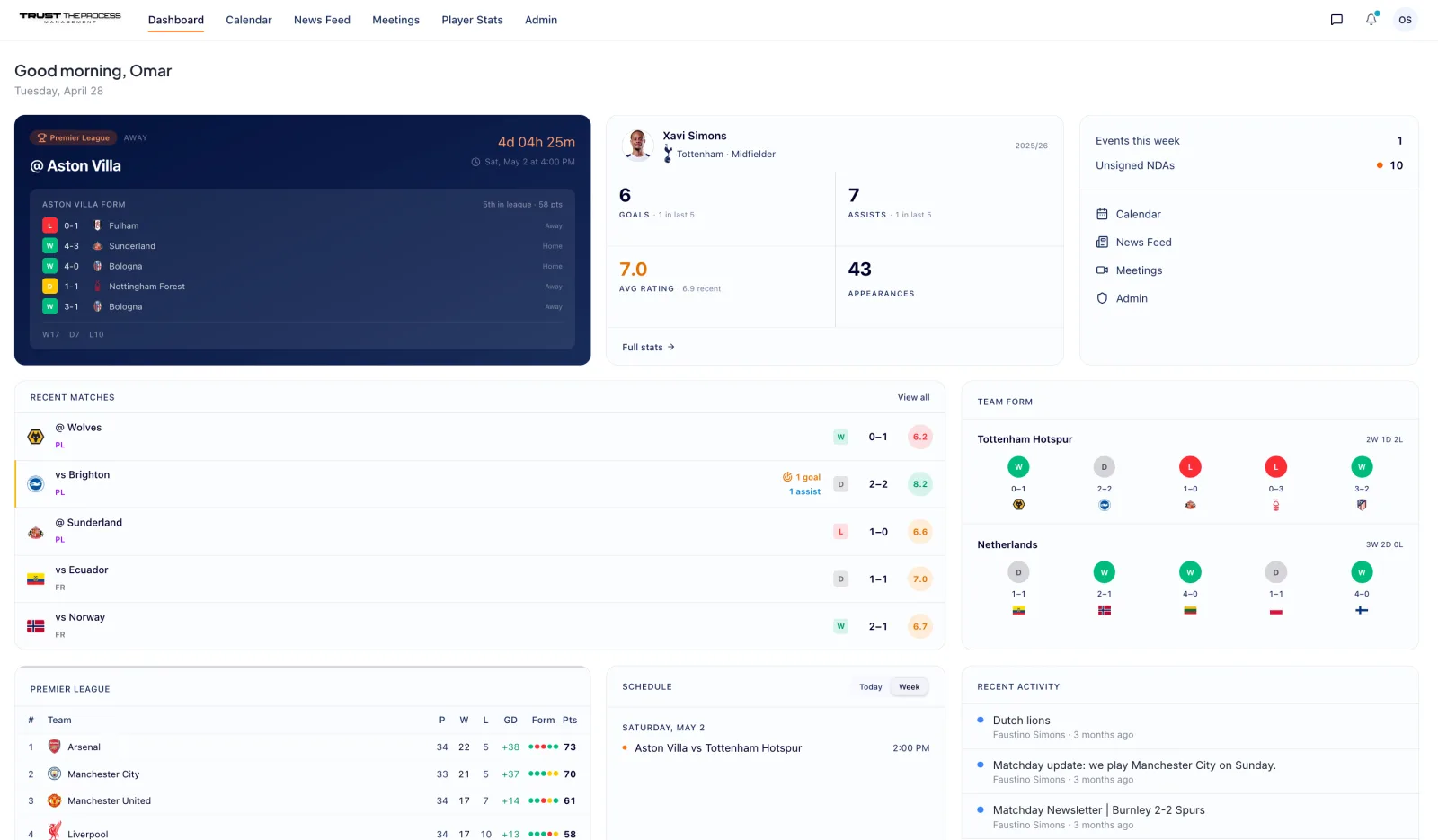
We built a player-specific management hub for Trust the Process Management. The platform combines football operations, team communication, meeting intelligence and compliance workflows in one role-aware application:
- A player-first dashboard with next-match context, player summaries, recent matches, team form, league-table information and quick actions for things that need attention
- A calendar for meetings and matches with day, week and month views, attendee visibility, RSVP status, physical or digital locations, and match metadata such as opponent, competition, stadium and home/away status
- Automated football-data sync through API-Football, refreshing fixtures, match stats, season stats and standings on a scheduled Vercel cron
- Zoom-integrated meeting creation for digital events, so meeting links are generated from the same workflow that manages the calendar
- AI meeting intelligence that turns transcripts into executive summaries, key points and explicit action items for a football player management context
- A private team news feed with updates, announcements, photos, milestones, pinning and lightweight reactions for internal engagement
- A newsletter workflow with TipTap rich-text editing and campaign management connected back into the internal communication layer
- A digital NDA and compliance layer with editable templates, signature tracking, PDF generation and pending-signature reporting
- Role-aware administration for user onboarding, profile data, departments, role assignment and permission-sensitive visibility
How We Built It
Three decisions shaped the product:
The data model follows the player context. Matches are not just calendar blocks; they carry opponent, competition, stadium, home/away and fixture-sync data. The dashboard is not a pile of vanity metrics; it is built around next commitments, football context and operational actions. That is what makes the product feel specific to one player's world rather than like a reskinned admin panel.
Roles are enforced below the UI. Admin, Manager and Staff access is backed by Supabase Auth, Postgres policies and permission helper functions. The app can tailor navigation and screens by role, but the important constraint lives in the data layer: users only receive the records their role and relationship allow.
Automation handles the repetitive coordination work. API-Football keeps match context fresh, Zoom removes meeting-link admin, and the OpenAI summarization layer converts transcripts into structured summaries and action items. The platform does not ask the team to maintain another database by hand; it pulls the operational work into the same place they already use to coordinate.
The stack stays modern but practical. Next.js 16 and React 19 provide the app-router foundation, Supabase handles auth, Postgres, storage and RLS, Server Actions keep mutations close to the routes, Zustand handles lightweight client state, TipTap powers rich text, and pdf-lib supports the NDA workflow. The architecture is straightforward on purpose: the complexity belongs in the workflows and access model, not in unnecessary infrastructure.
The Outcome
Trust the Process Management now has a single internal operating layer for player-management work: football commitments, meetings, team updates, newsletters, compliance and admin all live in one product instead of being spread across disconnected tools.
The biggest change is that the platform reflects the way the team actually works. Match context sits next to the calendar. Meeting summaries become structured follow-up. Compliance is visible instead of being chased manually. Admins, managers and staff each get the level of access they need without turning the UI into a one-size-fits-all control panel.
On the technical side, the codebase is set up so new event types, integrations, roles and dashboard widgets can be added without rewriting the foundation. The 28-table data model gives the product room to grow, while the role model keeps sensitive football-management information scoped correctly.
Why It Matters
Elite football management is a high-trust, high-context environment. The software has to understand matches, meetings, media, legal paperwork, support-team communication and privacy at the same time. If any of those pieces live in isolation, the team ends up doing coordination work around the tools instead of through them.
This project shows what bespoke software is for: not just digitising an existing workflow, but shaping the product around the people, context and decisions that actually matter.